
 By
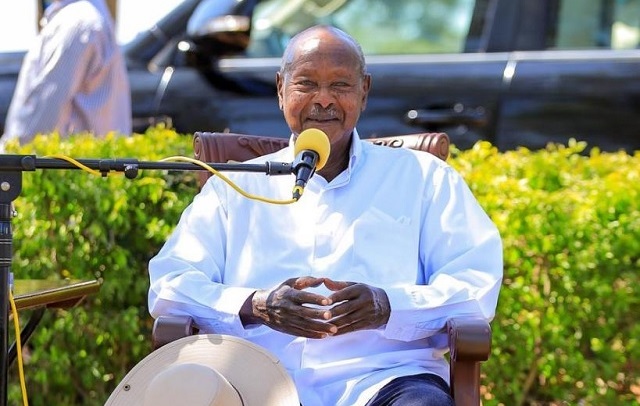
By KAMPALA,UGANDA; A past video of President Yoweri Museveni has resurfaced on social media, drawing renewed attention amid rising tensions involving the United States, Israel and Iran in the Gulf region.
The United States and the United Kingdom proposed deploying their military contingents to Uganda but were refused, Yoweri Museveni, president of the East African nation, said.
In the clip, recorded a couple of years ago, Museveni explains Uganda’s longstanding position against hosting foreign military bases and signing Status of Forces Agreements (SOFAs) that would grant foreign troops immunity from local prosecution.
Reflecting on the early years of his administration, Museveni says that when the National Resistance Movement (NRM) took power in 1986, Western governments offered to help build Uganda’s army. He declined the proposal, arguing that the force had already proven its capacity by capturing power.
“We said we don’t want to be over-involved,” Museveni states in the video. “We can share experience, but we don’t need foreign bases here. We can defend ourselves.”
Rejection of SOFA Agreements
Museveni recounts rejecting proposals from the United States and the United Kingdom for a Status of Forces Agreement commonly known as SOFA which would determine how foreign troops stationed in Uganda would be treated under the law.
According to the President, the proposed arrangement required that foreign soldiers accused of crimes in Uganda be tried in their home countries rather than in Ugandan courts.
Museveni says he questioned whether the agreement could be reciprocal so that Ugandan soldiers in the U.S. would also be returned home for trial if they committed offences there. He claims the proposal was rejected.
He adds that while minor infractions could potentially be handled abroad, serious crimes committed against Ugandans would have to be tried in Uganda.
“There’s no way we can say that you take him away to be tried somewhere else,” he says in the footage.
Museveni further asserts that Uganda has never signed a SOFA with any foreign country and does not host foreign military bases.
Link to Broader African Security Debate
In the same remarks, Museveni argues that some African countries citing Niger, Burkina Faso, Mali and the Central African Republic have faced instability due to what he describes as “over-involvement with foreigners” in their security sectors.
The resurfaced video has gained traction at a time when Iran has reportedly targeted U.S. military installations in the Gulf following heightened hostilities involving Washington and Tel Aviv. Online commentators have drawn parallels between Museveni’s comments on foreign bases and current geopolitical tensions in the Middle East.
Historical Perspective on African Liberation
In the clip, Museveni also reflects on Africa’s liberation struggles, recalling the formation of the Organization of African Unity in Addis Ababa in 1963, when 36 African states were independent.
He references leaders such as Kwame Nkrumah, Julius Nyerere, and Gamal Abdel Nasser, who pushed for the complete political independence of the continent.
Museveni highlights the armed struggles led by liberation movements including FRELIMO in Mozambique and the MPLA in Angola, noting that by 1974 Portugal’s colonial empire in Africa had collapsed.
He further cites Zimbabwe’s 1980 independence and Namibia’s 1990 independence as examples of African-led victories, supported in part by China and the former Soviet Union, as well as Western social democratic groups.
Renewed Debate
The circulation of the video has sparked fresh debate online about Uganda’s foreign policy posture, military sovereignty and the broader question of foreign military presence on African soil.
While the remarks were made years ago, analysts say their renewed visibility reflects ongoing global realignments and growing scrutiny of foreign military deployments worldwide.
Uganda currently contributes troops to regional and continental missions, including the African Union Support and Stabilization Mission in Somalia (AUSSOM), but maintains that its defence policy is anchored on national sovereignty and self-reliance.